Just 'Don't' Do It
Why doing 'nothing' for long periods of time is probably the key to maximum returns.

In an interesting conversation between Patrick O'Shaughnessy and Barry Ritholtz about a Fidelity study on which investor portfolios performed the best over the long term, Patrick asked Barry which accounts he thought did the best over the long term, to which Barry replied:
"Those who were dead?"
O'Shaughnessy replied to Barry: "No, that's close though! They were the accounts of people who forgot they had an account at Fidelity."
These investors had done nothing with their portfolios because they had forgotten about them over the long term or because of their death.
Here’s my take on this: The dead don’t suffer from cognitive biases like the living :)
In investing, the maximum movement in our portfolios comes from doing nothing.
Ironically, the maximum number of investors focus on constantly doing something new, when doing nothing and just sticking to the same plan and process over long periods of time is what works.
In this great interview with Samit Vartak, I came across an interesting data point at minute 7:00 onwards:
‘The Sensex has gone up 670x from 1979 to 2024, and there were 10,500 trading days during this period. If you rank the days from best to worst, the top 112 days have contributed to the entire 670x returns that the Sensex has delivered over this period.
These 112 days account for around 1% of the total number of trading days!’
You would have to be a prophet to have been able to time your entry and exit to ensure that you did not miss those days. If you are a human being, then chances are you would have missed out on the best-performing days because no one knows when they happen.
Research done by Zerodha Varsity highlights a similar theory that missing just 10 days of being invested in the market from October 2003 to October 2023, which is a fairly long sample size, would cause your returns to differ from 15.7% CAGR to 11.6% CAGR—a 4.1% CAGR difference over 20 years. This means that the 1 lakh you invested in 2003 would be only Rs 9 lakhs if you had missed the top 10 trading days, as opposed to Rs 18.6 lakhs as your final amount if you had stayed invested through the ups and downs.
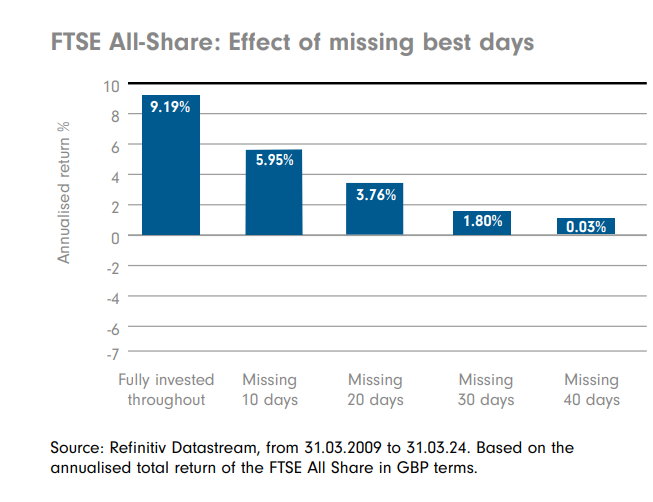
Of course, it gets worse as you miss more days, which the chart clearly highlights.

These charts and data highlight the importance of doing nothing once you have a set investment plan in place. If you had tried to be smart and get in and out of the markets with your sharp insights, chances are you would have missed out on a large part of the returns.
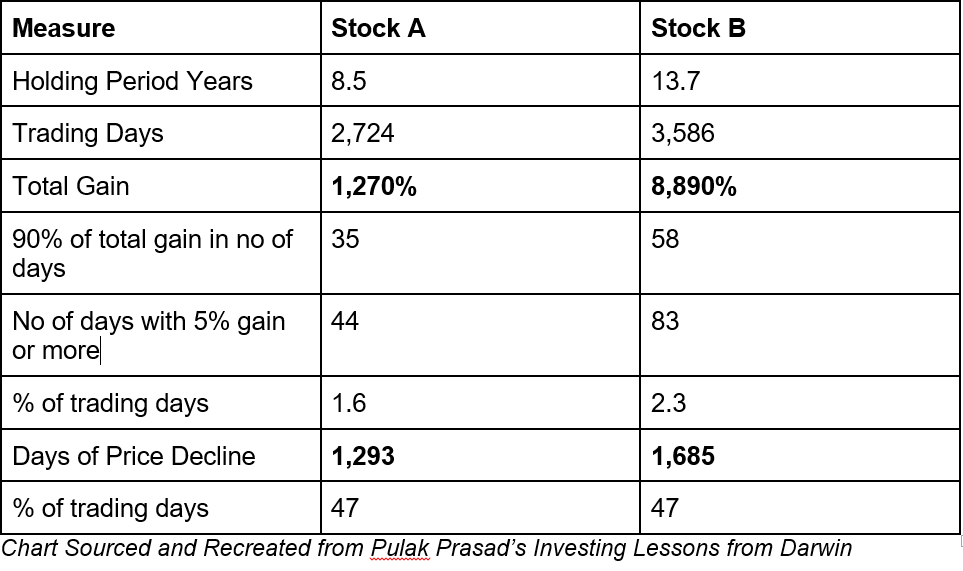
From one of my favorite books on investing, I came across the famous Nalanda Capital style of staying invested for long periods of time and doing nothing, with examples of two stocks that have been big winners over a long period in their portfolio. I renamed the stocks to A and B to maintain anonymity.
Learnings from these two winners:
A mere thirty-five days accounted for 90% of the total gains made for Stock A, and a mere 1.6% of the trading days were days with 5% gains or more.a
A mere fifty-eight days accounted for 90% of the total gains made for Stock B, and a mere 2.3% of the trading days were days with 5% gains or more.
The point of this data is to show you that the maximum number of returns for these two stocks has come from the least number of trading days, and it’s impossible to predict when these would come without being invested.
Now let’s see if the same examples can be used for other global markets without bias toward Indian markets only.
The difference between being fully invested over a 14-year period and missing just 10 days of the market resulted in your earning a 3.24% lower annualized return over this period with the FTSE (UK markets).
And if you happened to miss 40 of the best-performing days, then don’t even bother; you basically earned nothing.
Source: When Doing Nothing is Best
What about the US markets, the biggest markets in the world?
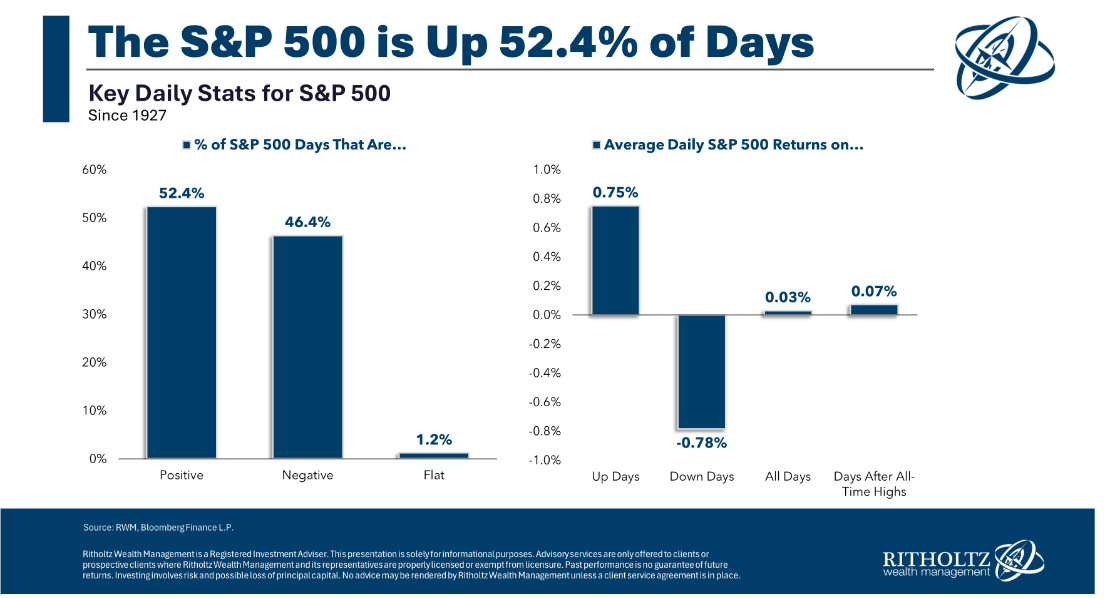
Well, a study done by Ritholtz Wealth Management points to a similar thesis when the S&P 500 data was studied over nearly a 100-year period.
Source: Ritholtz Wealth Management
To put the above chart into perspective, the S&P 500 (US market) is up close to 39,000% since 1927.
52.4% of those positive days dictated your net return of 39,000% inclusive of the negative days.
You would have to basically flip a coin to know if a day is going to be good or bad in the markets, which is purely based on chance.
Of course, we may actually be dead over such a long time period, but this is just to further highlight the importance of doing nothing over a long period of time to maximize your return.
This seems like the ideal scenario for wealth creation and is easier said than done because emotions cannot be quantified, but data never lies.
We may also need the funds to make our big-ticket purchases or even use them to meet certain dire emergencies in life.
The point of this piece is not just to stay invested forever; it is to say that while we are invested, it is nearly impossible to predict the days when you will generate maximum returns, and missing out on those days seems to dictate a large part of your returns.
I chose data sets of very long time horizons to ensure that the principles of this piece remain evergreen.
Conclusion
Doing nothing works, but only if we have a sound financial plan in place.
For stocks, this theory may not apply, as a business can change for better or worse based on a whole host of factors, but for the overall markets in a stable and growing economy, it probably remains relevant.
Without a disciplined plan and process, doing nothing can lead to ruin.
There are costs associated with both the actions we should take and those we should avoid.
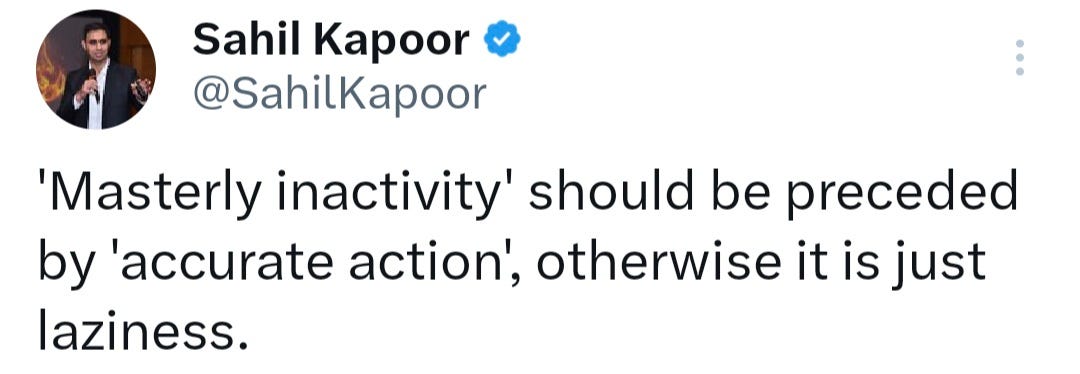
This tweet sums up my conclusions beautifully:
Relevant Reads from My Blog:
I had read somewhere that the best days come exactly after the worst days ! Those who quote the above dnt tell this as they sell their product maybe !!
I think I agree with what you've penned down. We either out to carry out a planned routine and follow it every day - which sorta turn out to become our everyday habits - so we're almost doing nothing, I guess. And as we do nothing each day.. we suddenly see that we've come a long way when we look back. Of course - doing nothing doesn't actually mean nothing. 🙂↕️😂