
Roger Federer recently gave a speech at Dartmouth and he had this to say:
"Perfection is impossible.
In the 1,526 singles matches I played in my career, I won almost 80% of those matches.
But what percentage of points did I win? 54%
In other words, even top-ranked tennis players win barely more than half the points they play.
When you lose every second point on average, you learn not to dwell on every shot.
You teach yourself to think: 'Okay, I double-faulted...it's only a point.' '
Okay, I came to the net and I got passed again...it's only a point.' Even a great shot, an overhead backhand smash that ends up on ESPN's top 10 playlist – that too is just a point. Here's why I'm telling you this. When you're playing a point, it has to be the most important thing in the world.
And it is. But when it's behind you, it's behind you. This mindset is crucial – because it frees you to fully commit to the next point with intensity, clarity, and focus."
The point he is stating is that a large part of the alpha comes from the least amount of time spent but it still implies that you have to stay in the game.
Those 54% points won, dictated his 80% win rate!
Pulak Prasad of Nalanda Capital highlights this phenomenon in his book with two stocks that their fund held for almost 10-year periods each, but most of their gains came from just a short period, emphasizing why it was so important to remain invested.
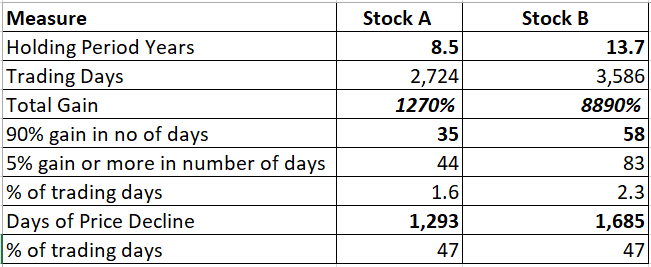
Source: Chart Sourced and Recreated in Excel from Pulak Prasad’s Investing Lessons from Darwin
Observe the data in the chart. Each stock has given magnificent returns over their holding periods: but 90% of the returns have come from 35 days only and 58 days only. Most investors would have been worried mainly about those 1,293 and 1,685 days of price decline and would have exited the stocks.
Hence multi-bagger stocks are mostly social media anecdotes, very few are able to actually hold them for long periods of time and reap the rewards.
I interviewed Sahil Kapoor, a fellow peer in the industry, who works in the asset management industry and is a disciple of health and fitness. We first connected on Twitter, as Sahil keeps sharing valuable insights on the markets and health which naturally attracted me to his content.
The interview was mainly for a chapter of my upcoming book.
Sahil embodies the principles of discipline and consistency in his approach to work and investment philosophy. He applies similar habits to his health routines.
I asked Sahil about his views on the process of compounding and he explained it by drawing on the theory of evolution.
He mentioned that compounding involves days with sudden leaps in progress, but for years, one must endure the boring and stagnant phases. This phenomenon can be explained through a concept in evolution known as punctuated equilibrium. This theory suggests that most species remain unchanged for millions of years, followed by rapid periods of change leading to the emergence of new species.
Similarly, adopting high-performance habits and repeating them leads to results in the form of punctuated equilibrium. The outcomes can be non-linear, occurring either early or late. This means our actions guarantee results, but not the exact timing of their fruition.
Drawing another analogy from the theory of evolution, Sahil explained how compounding is nature's fundamental process. A cell self-replicates, eventually forming a complete organism without a blueprint of the entire organism. The cumulative effect of these cells results in the emergent property of life, where the sum of all vital organs and processes is greater than the individual parts.
This is life; this is compounding—an unpredictable convergence of tiny, repetitive, and persistent self-replicating wonders.
This same phenomenon ties back to Sahil Kapoor’s example of sudden spurts in the process of compounding; it happens in the same way when investing your money in the markets.

Source: Zerodha Varsity Research
Research done by Zerodha Varsity highlights this fact. Most of the value earned in the process of compounding is from sudden spurts during the best days of the market. Missing these days can cause a large deviation in your returns.
Ben Carlson highlighted this same phenomenon that takes place in the US Stock Markets. All the massive gains that an investor would have gotten would have been throw this 52.4% of positive days. However, the only way to have the best up moves is to stay invested because it is extremely difficult to predict how the markets will move over the short term.
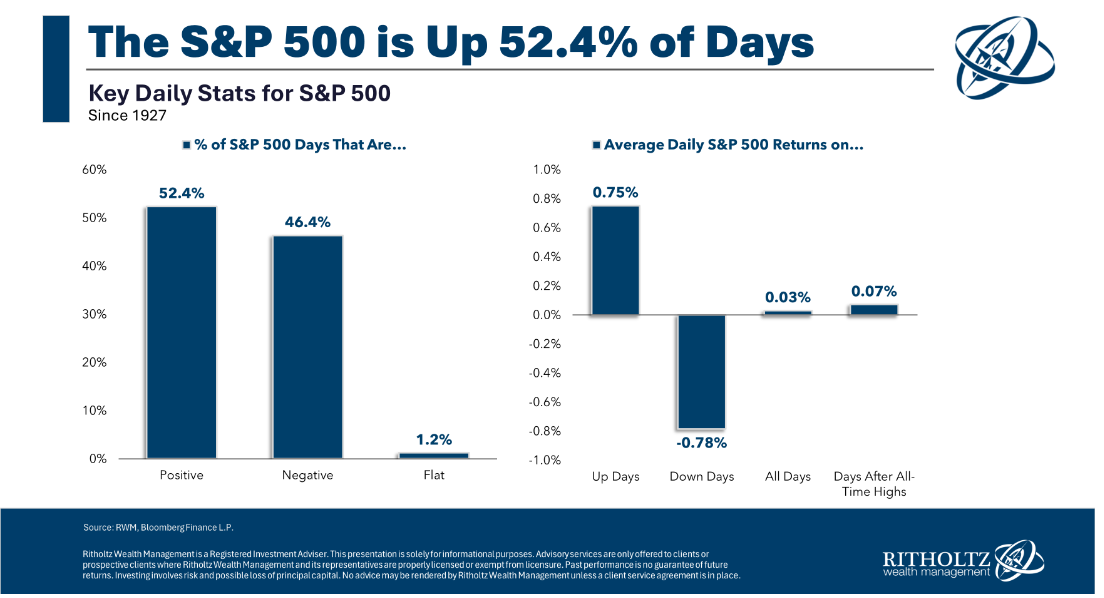
Source: Ritholtz Wealth Management, Ben Carlson Newsletter
(FYI ON A SIDE Note; I beat Ben to the Roger Federer and Stock Market analogy in terms of timing, my LinkedIn serves as proof and probably not my Substack. This is for Ben if he is reading this)
"What appears to be a rapid shift is often preceded by a gradual process. Our results gradually explode or vanish thanks to the small habits we repeat each day.
What radical change are you slowly marching toward? An incremental explosion or an incremental vanishing?"- James Clear
A Chinese bamboo tree takes more than five years to start growing, but once it starts, it grows rapidly to eighty feet in less than six weeks.
Conclusion:
Stay in the game. That is literally all I have to say.
Your biggest wins are generally just waiting to explode but that can happen only if you continue to play the game for long periods of time.
Good one.....though I beat both you and the Ben guy to this! ;)
very nice article